

.jpg)
Introduction
A common objective in engineering is design optimization: modifying the shape of a component to achieve desired physical properties. Central to this is the connection between geometry and physics. Traditionally evaluated through slow numerical simulation, today these relationships can be approximated by physics AI models in a fraction of the time, enabling much faster iteration.
But computing physics is only half the story. A fast optimization is of limited use without a rich set of geometries to explore, and these design spaces have remained largely unchanged. Most workflows continue to rely on low-dimensional parametric CAD, meaning that no matter how exhaustive the search, it remains trapped within a representation that is both costly to construct and bounded by a predefined parameter set.
Progress in 3D generative modeling offers an alternative. By learning a distribution of plausible geometries directly from data, generative models bypass the need for a CAD parameterization entirely, allowing for far greater flexibility in accessible designs. The crux is then how to learn such a distribution for engineering objectives, which turns out to be difficult in practice. Real-world engineering problems are typically constrained by small datasets that make training from scratch impractical, while existing foundation models are built for 3D content creation, a setting with far softer requirements than performance engineering.
In this blog, we present a principled approach for adapting 3D foundation models to complex, data-constrained engineering settings. We then show how to use these models for design optimization by steering generation toward specific criteria, such as target physical properties or design specifications, using techniques applicable to the broad range of physics, scales, and objectives we encounter in our clients' industries.
Adapting 3D Foundation Models for Engineering
For media such as text, images, or even molecules, pre-trained generative models that work out of the box for many use cases already exist. Engineering geometry has no such luxury. Though 3D foundation models such as TRELLIS.2 (Xiang et al., 2026) and Hunyuan3D-2.1 (Tencent, 2025) learn strong geometry priors through large-scale pre-training, they are built for generating visually appealing 3D assets from image prompts, rather than functional engineering components. Properly exploiting their prior understanding of shapes is therefore more involved. We describe one approach below, using TRELLIS.2 as an example.
Extracting the geometry prior
We start by stripping the model down to just the parts we need, which means removing the image conditioning. Conveniently, models trained for classifier-free guidance (CFG; Ho & Salimans, 2021) learn to generate both with and without image prompts, using a designated “null” token to signal when the image is absent. We can use this null token instead of an image embedding to sample unconditionally, giving us access to the geometry prior. However, the model still routes the token, which is now a fixed input, through the full conditioning pathway. In TRELLIS.2, this accounts for over 235M cross-attention parameters in each generative model, resulting in significant redundant computation.
With a small trick, this can be avoided. Cross-attention mixes conditioning information into the model state by attending over the context $C$, which in the standard case is the image embedding:
$$\text{CrossAttn}(X,C) = W_o \cdot \big(V[C] \cdot \text{softmax}(K[C]^\top Q[X])\big)$$
for
$$Q[X] = \beta_q\mathbf{1}^\top + W_q X, \quad K[C] = \beta_k\mathbf{1}^\top + W_k C, \quad V[C] = \beta_v\mathbf{1}^\top + W_v C$$
In TRELLIS.2, the null token is simply zeros. Notice that setting $C = \mathbf{0}$ reduces the keys and values to their bias terms only. With all keys identical, attention is spread uniformly, meaning we average over the values. But as the values are identical too, that average just returns the bias itself. Cross-attention under the null token therefore reduces to a fixed constant, independent of X:
$$\text{CrossAttn}(X, \mathbf{0}) = W_o \cdot (V[\mathbf{0}] \cdot \text{softmax}(K[\mathbf{0}]^\top Q[X])) = (W_o\beta_v)\mathbf{1}^\top$$
Precomputing this bias allows us to drop over 700M total parameters from TRELLIS.2’s three generative models, leading to speedups of around 60% per model evaluation (notably, the result is not specific to the zero case: it generalizes to any cross-attention model with a fixed null token and can be applied to the unconditional path of normal CFG sampling). This gives us a set of fully unconditional models from which we can sample the prior directly, as seen in Figure 3.
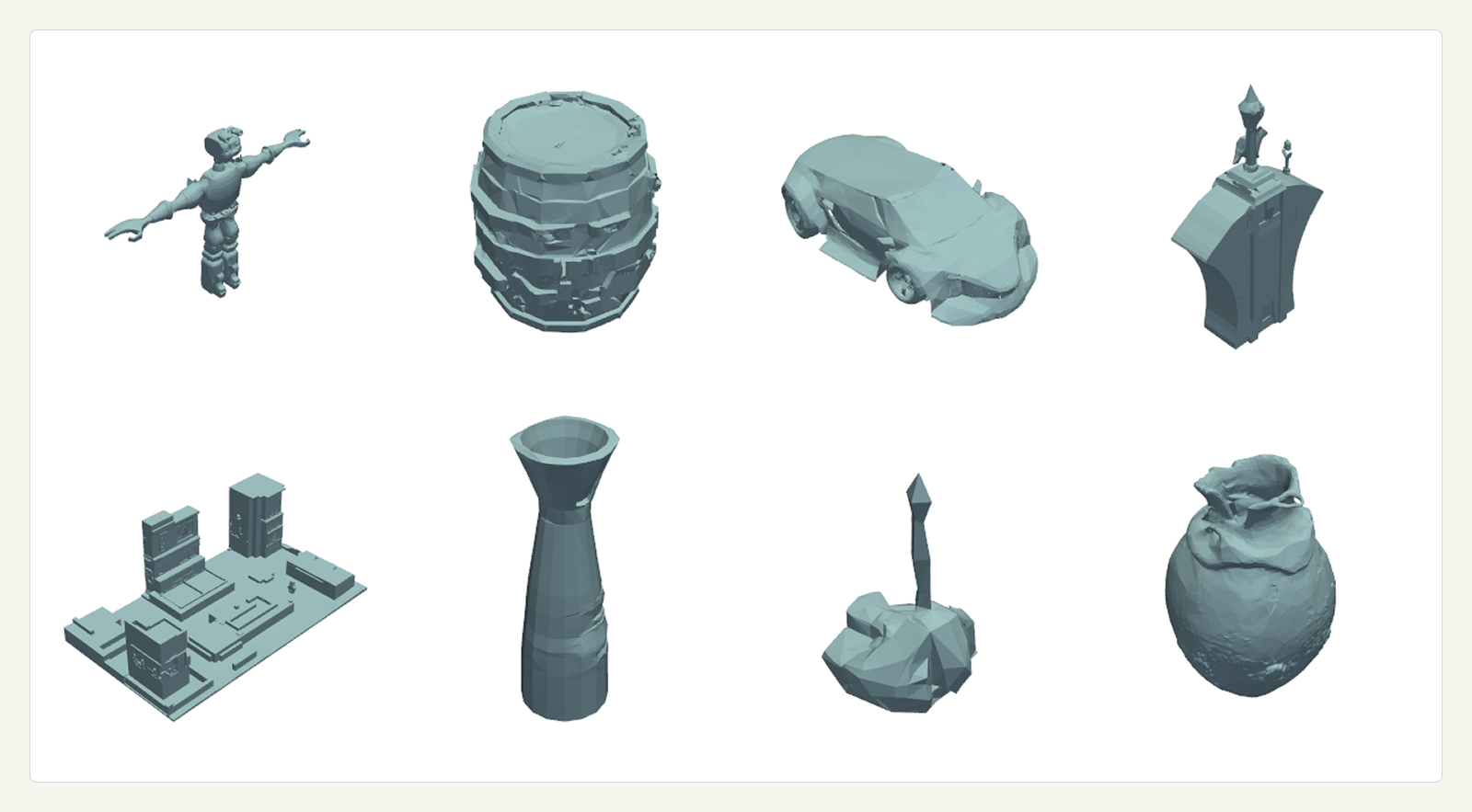
These (somewhat eerie) samples reflect the model’s pretraining: large-scale 3D datasets consist predominantly of creative assets, simply because this is the type of labeled 3D data that exists at scale. Engineering geometry, by contrast, is rarely shared publicly, motivating transfer learning. But given that these samples look nothing like industrial components, it's not immediately clear how transferable this pre-training is to engineering domains.
From creative assets to engineering geometry
To assess this, we make use of Low-Rank Adaptation (LoRA; Hu et al., 2022) to efficiently fine-tune these models on the small, complex datasets we face in real-world engineering problems. For TRELLIS.2, we apply LoRA such that approximately 1-10M of each flow model’s 1B parameters are trainable, enabling fine-tuning to be performed on a single GPU. As shown in Figure 4, this process adapts the pre-trained geometric prior into a new distribution over engineering geometries of interest.
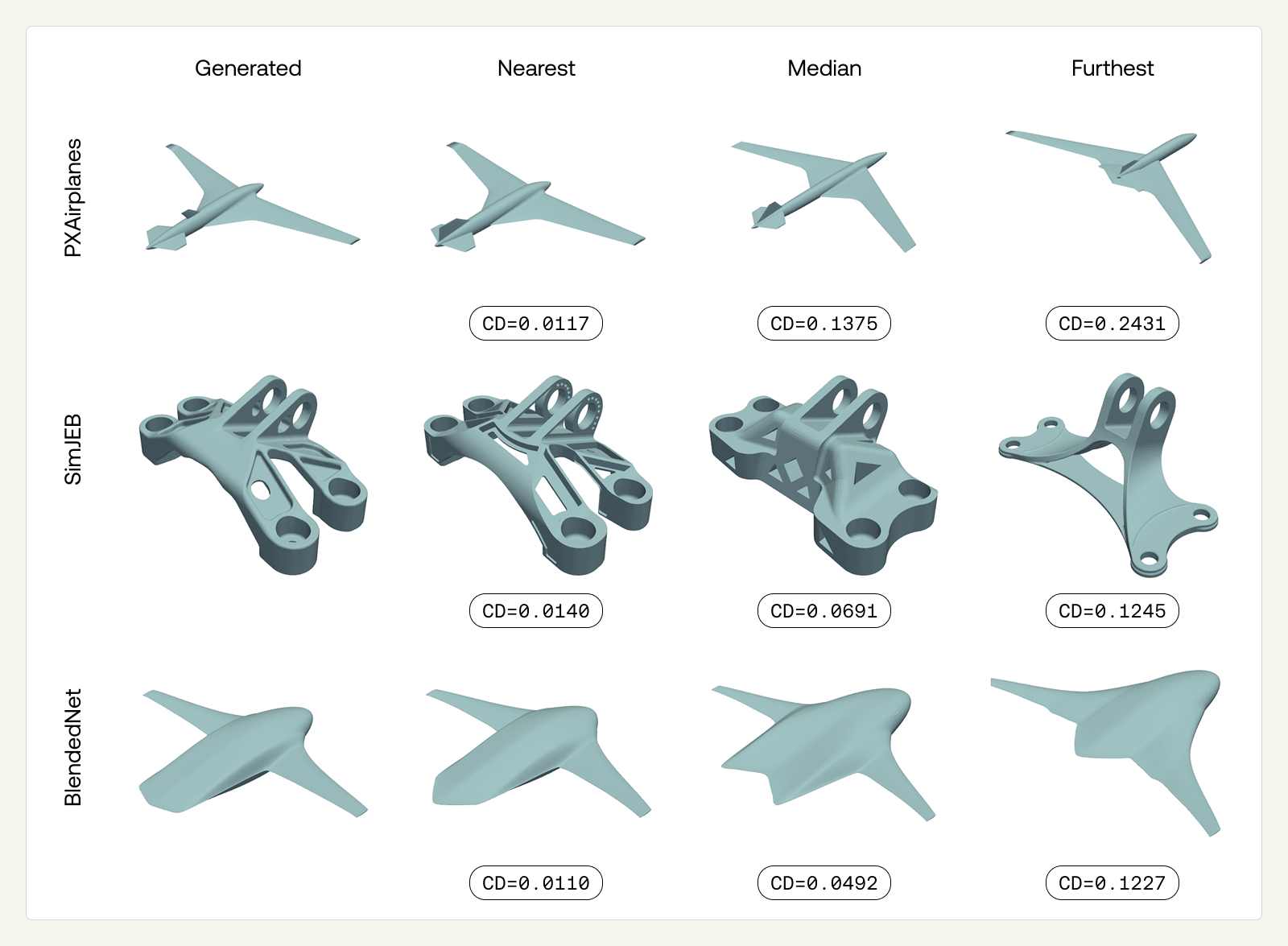
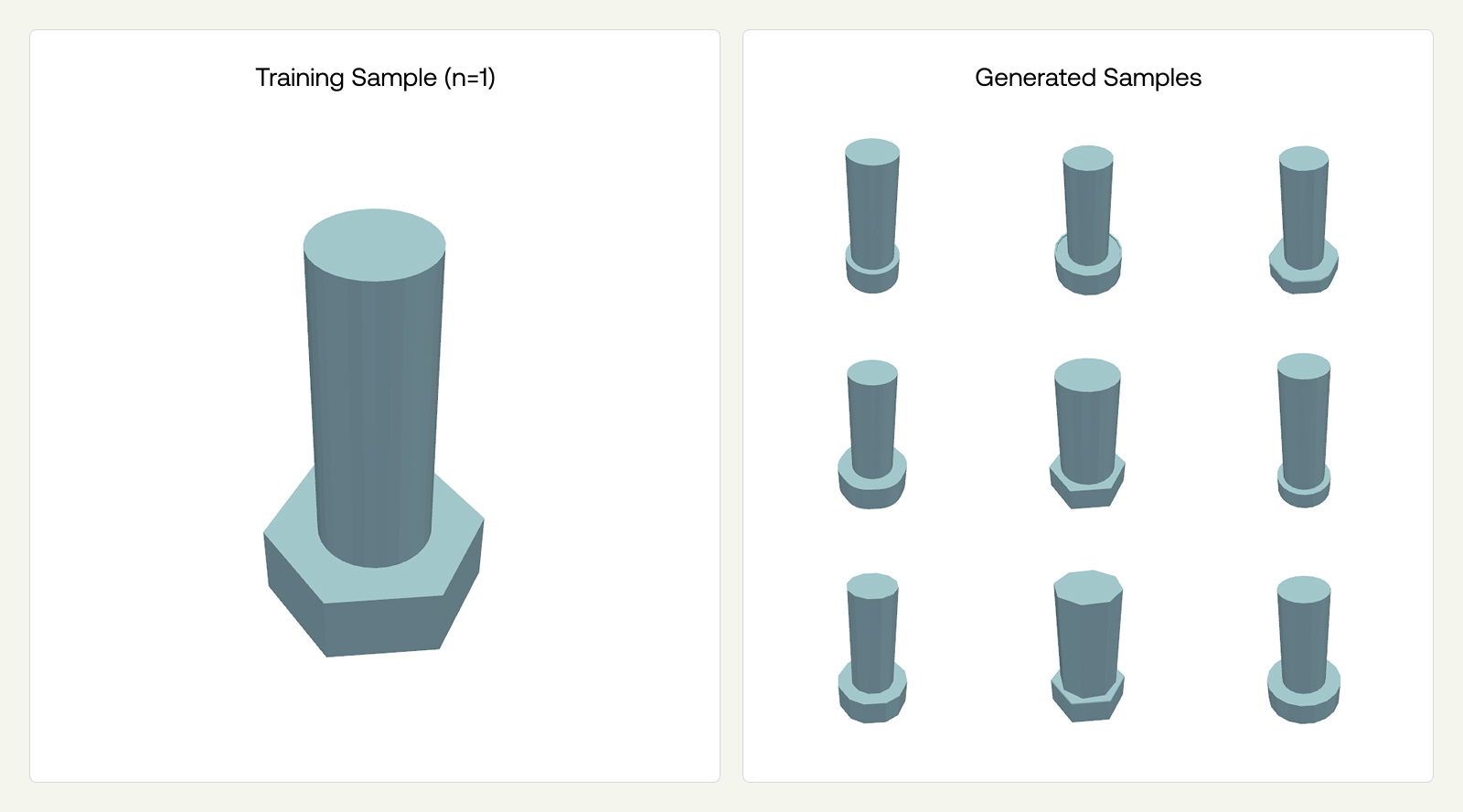
We find that this setup is remarkably robust to small dataset sizes. As an extreme example, we fine-tune on a single bolt with no data augmentation and are still able to generate samples with physically meaningful variations, extrapolating well beyond the training set. This suggests that the prior learnt over 3D assets is indeed useful for engineering objectives, perhaps a symptom of the often visual nature of human engineering design.
From sample to simulation
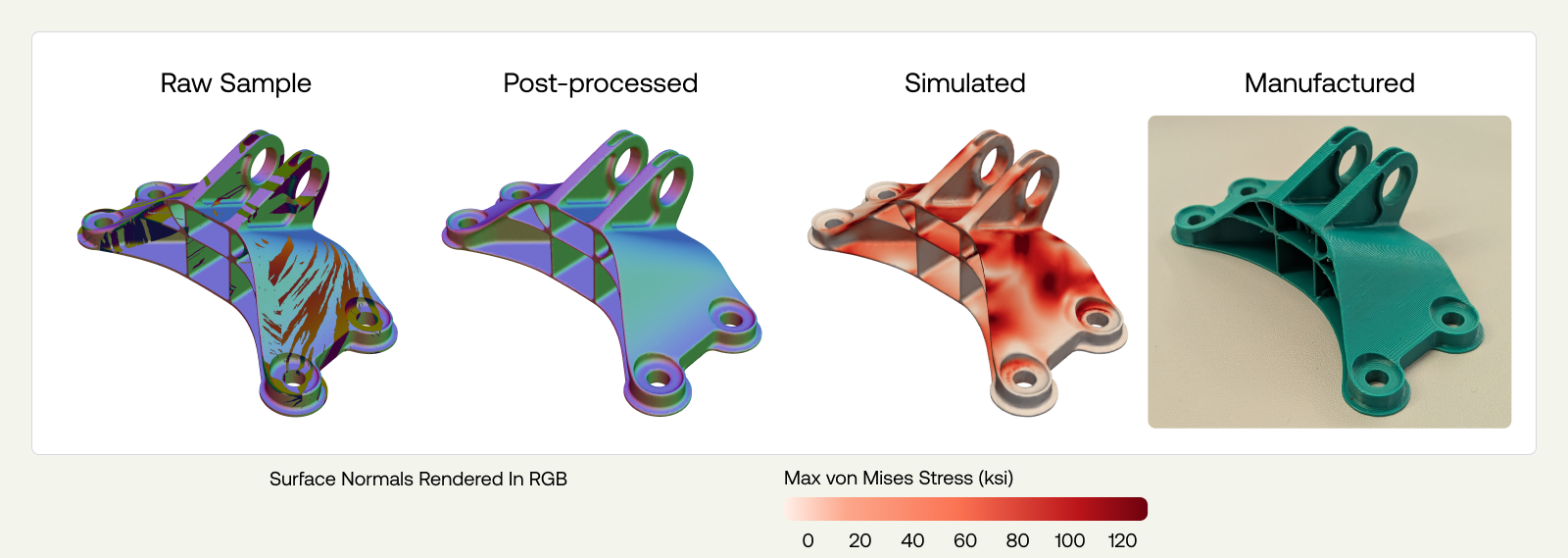
In choosing a geometric VAE, there is an inherent choice of mesh representation. TRELLIS.2 uses a field-free, dual-contouring based approach that can capture sharp edges and internal structures effectively. The trade-off for this flexibility is that it permits non-manifold outputs, meaning that sampled meshes are not immediately ready for simulation or other downstream engineering workflows.
The more common approach, found in Hunyuan3D-2.1, is to decode through a neural field into an implicit representation, from which meshes are reconstructed using marching cubes (MC). An advantage of this is that MC can guarantee manifoldness. However, in some engineering domains, even advanced adaptive MC algorithms require a prohibitive number of decoder evaluations to accurately reconstruct sharp or thin features that are critical for physics, such as the trailing edge of an airfoil.
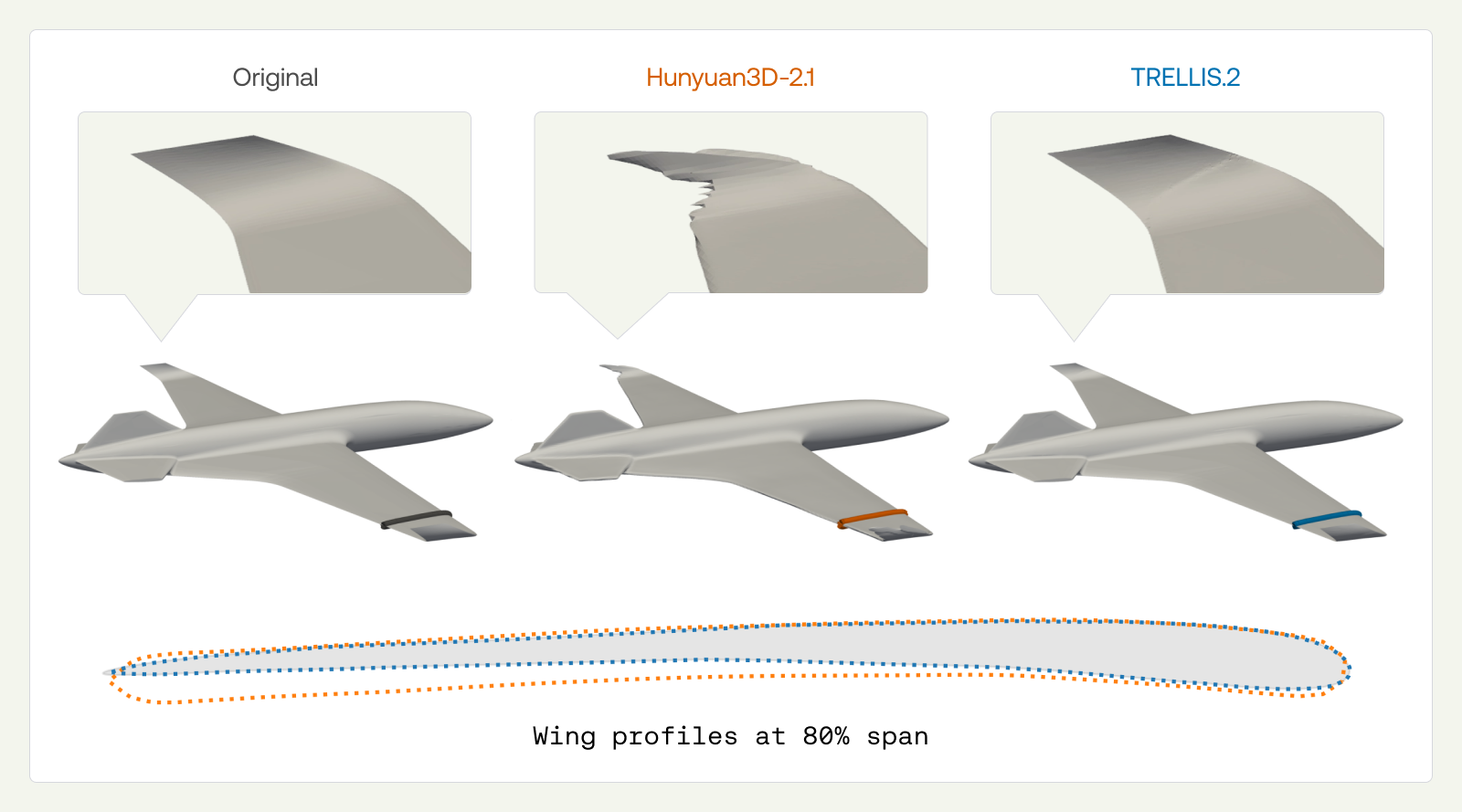
Despite this, implicit representations remain common in generative engineering research. We suggest two reasons for this practicality gap: benchmark datasets such as DrivAerNet are too simple to expose these limitations, and literature results are often evaluated using learned surrogate models (which typically don’t generalize to these geometric defects) rather than numerical simulation.
Validation through numerical solvers is non-negotiable for real engineering workflows. Though there is no perfect representation for engineering, we find that refining a high-fidelity but structurally degenerate mesh is more tractable than improving MC reconstructions via large neural field decoders. In both cases we use robust post-processing pipelines, building on recent advances in geometry processing, to ensure generated samples can be evaluated using the same production-grade solvers we use for CAD geometries.
Generative Optimization
We now have a simulation quality generative model over a distribution of interest, and return to our original task of design optimization. In general, the goal is to search our design space for geometries that score highly against a given objective $f$, such as a physical performance criterion. In the traditional setting this is usually posed as an optimization problem:
$$x^* = \underset{x\in \mathcal{X}}{\operatorname{argmax}} \, f(x)$$
where the design space $\mathcal X$ (and thus geometry $x$) are defined by a CAD parameterization. A natural generalization is to soften the argmax into a tilted distribution towards higher objective values:
$$p_{\beta}(x) \propto \underbrace{p_{\theta}(x)}_{\text{Prior}}\cdot\underbrace{\exp \left(\beta\cdot f(x)\right)}_{\text{Reward/Likelihood}}$$
where $p_{\theta}(x)$ is our generative model and $\beta$ controls how sharply the distribution is tilted toward higher performing designs. This is equivalent to a Bayesian posterior, with the generative model acting as prior and the tilting exponential as likelihood.
Beyond removing the constraint that $x$ must be defined by CAD parameters, there are two philosophical differences with the traditional approach: our prior now regularizes the optimization, and we no longer seek a single shape but consider the distribution of optimal geometries. Both effects diminish as $\beta \rightarrow \infty$, recovering the classical optimum.
This framing of posterior sampling unlocks a diverse set of tools that can be applied to our setting. Below, we briefly highlight three that cover a broad set of use cases.
Teaching a generative model physics
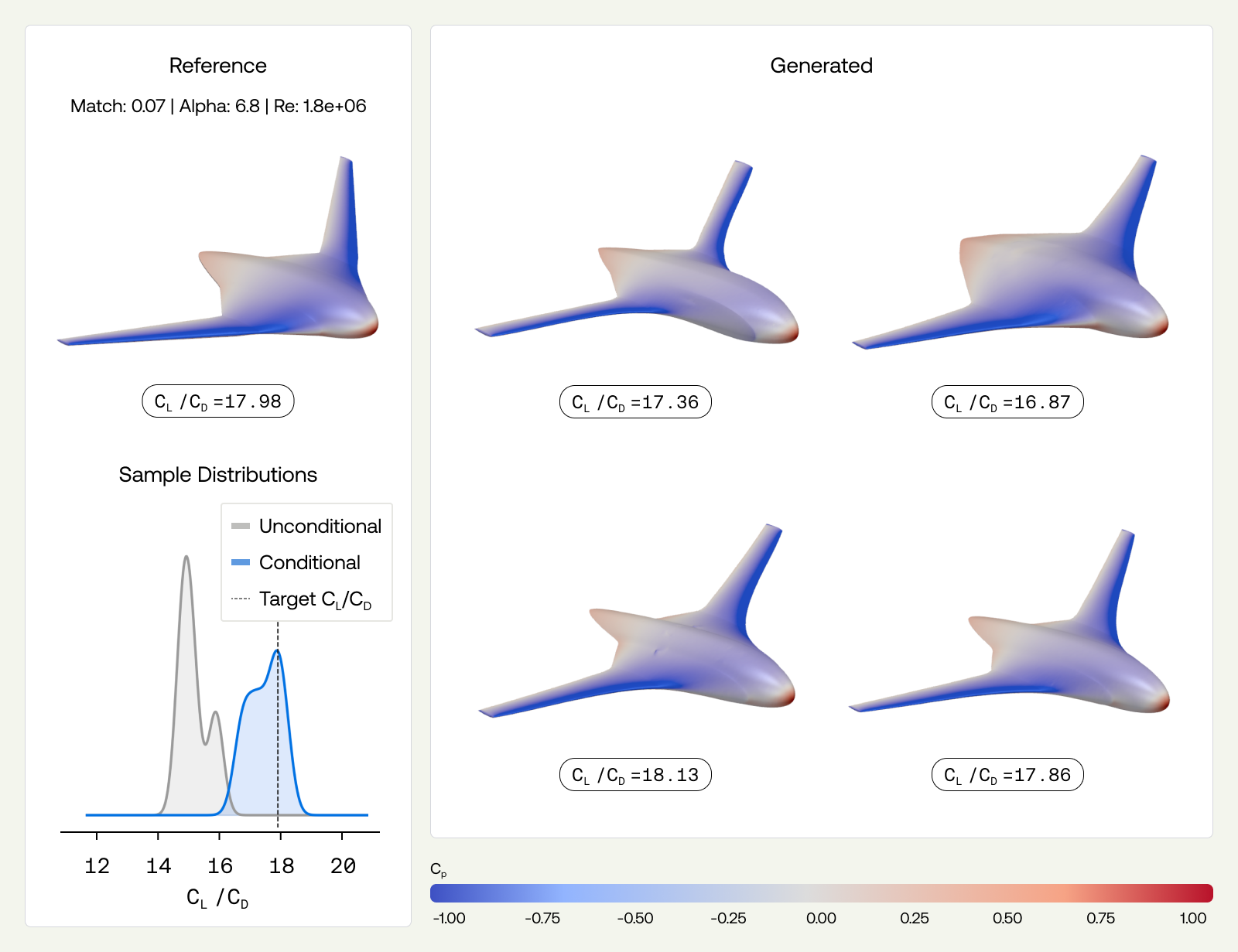
Classifier-free guidance — the mechanism behind the original image conditioning — is a well-established method that has been applied to generative optimization in materials design (Zeni et al., 2025). CFG requires modifications during training: the generative model learns a conditional distribution directly from a labeled dataset, with a guidance scale parameter playing the role of $\beta$ during inference.
We reintroduce a conditioning path into our unconditional models using adaptive layer normalization rather than cross-attention, initializing such that unconditional behavior is preserved at the start of training. As a concrete example, we revisit the inverse design task of BlendedNet++ (Sung et al., 2026), which generates aircraft with a target lift-to-drag ratio at given flight conditions. However, where the original generates CAD parameters, we generate geometries directly, bypassing the need for a parameterization at any stage of the process.
However, CFG has some limitations in its flexibility. Complex objectives involving secondary conditions or nuisance variables can become intractable, while any change to the objective requires retraining the flow models.
Steering generation with reward gradients
Rather than baking the objective into the model weights, a more general strategy is to replace CFG’s learned likelihood with one defined at sample time. A family of approaches, for which diffusion posterior sampling (DPS; Chung et al., 2023) is the canonical example, use gradients of a differentiable reward model to steer generation toward high-performing samples. One intuitive application is (soft) inpainting: we assign high reward values to geometries that are similar in some predefined area, while the rest of the shape is free to vary.
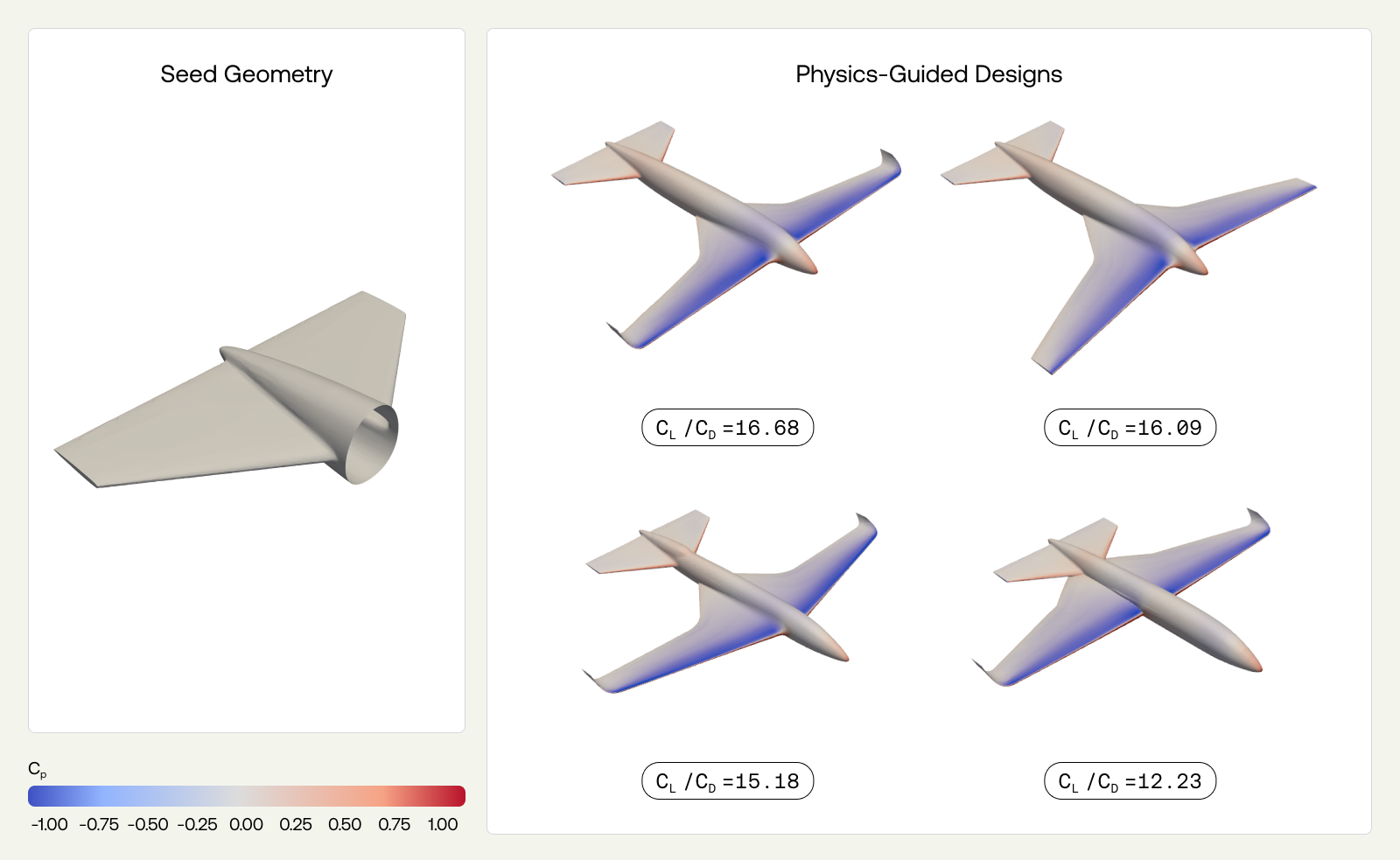
Physics objectives such as aerodynamics typically rely on non-differentiable numerical solvers, which cannot directly guide generation in this way. The solution is one we are very comfortable with at PhysicsX: we learn a differentiable surrogate model for the simulation, and use this as the reward. Unlike CFG, these reward models can be easily exchanged, updated or even combined as in Figures 10 & 11, allowing for the same underlying generative model to be used to target many diverse problems.
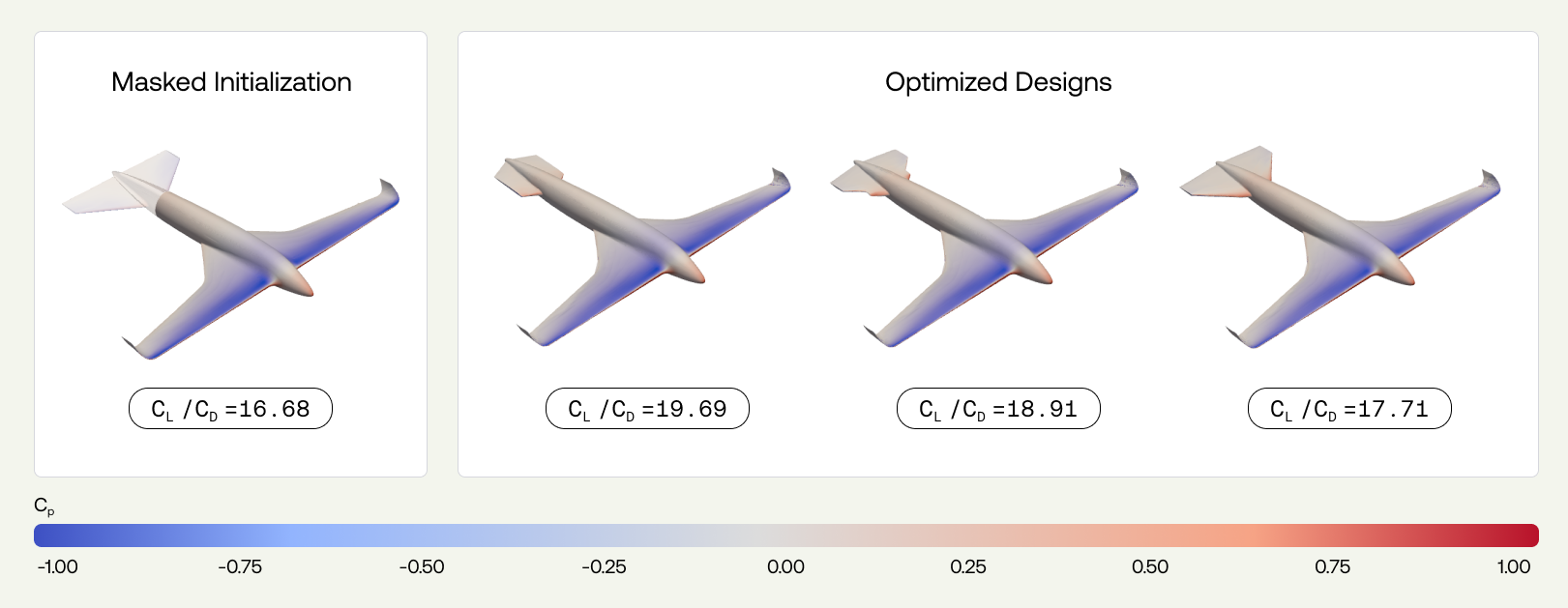
However, the performance of any machine learning model degrades as it moves beyond its training distribution, which makes our guidance signal less reliable. This is particularly important in generative optimization, where the goal is to explore novel designs. One solution is to build more general physics AI models, pre-trained on large and diverse datasets to improve out-of-distribution performance. This is one of the reasons we are actively developing Large Physics Models (LPMs): to learn more general representations of physics that can transfer across broader design spaces.
Putting the simulator in the loop
Despite their non-differentiability, the gold standard for reward models remains the numerical simulation itself. Additionally, VAE structure or post-processing steps can prevent surrogate models from having access to the complete computational graph required for gradient guidance. This creates a role for approaches that can make use of these “evaluate-only” rewards, either directly or as part of a multi-fidelity pipeline.
To do so we turn to SDEdit (Meng et al., 2022), a method for producing novel, in-distribution variants of a geometry by passing it through a partial forward and reverse diffusion process. This can be adapted into a genetic algorithm: each iteration “mutates” a candidate using SDEdit and retains it if it improves a non-differentiable reward, in the spirit of an MCMC acceptance in the $\beta \rightarrow \infty$ limit. The method composes with the sampling approaches above, as well as with other optimization paradigms, for example by initializing with a previously optimal mesh.
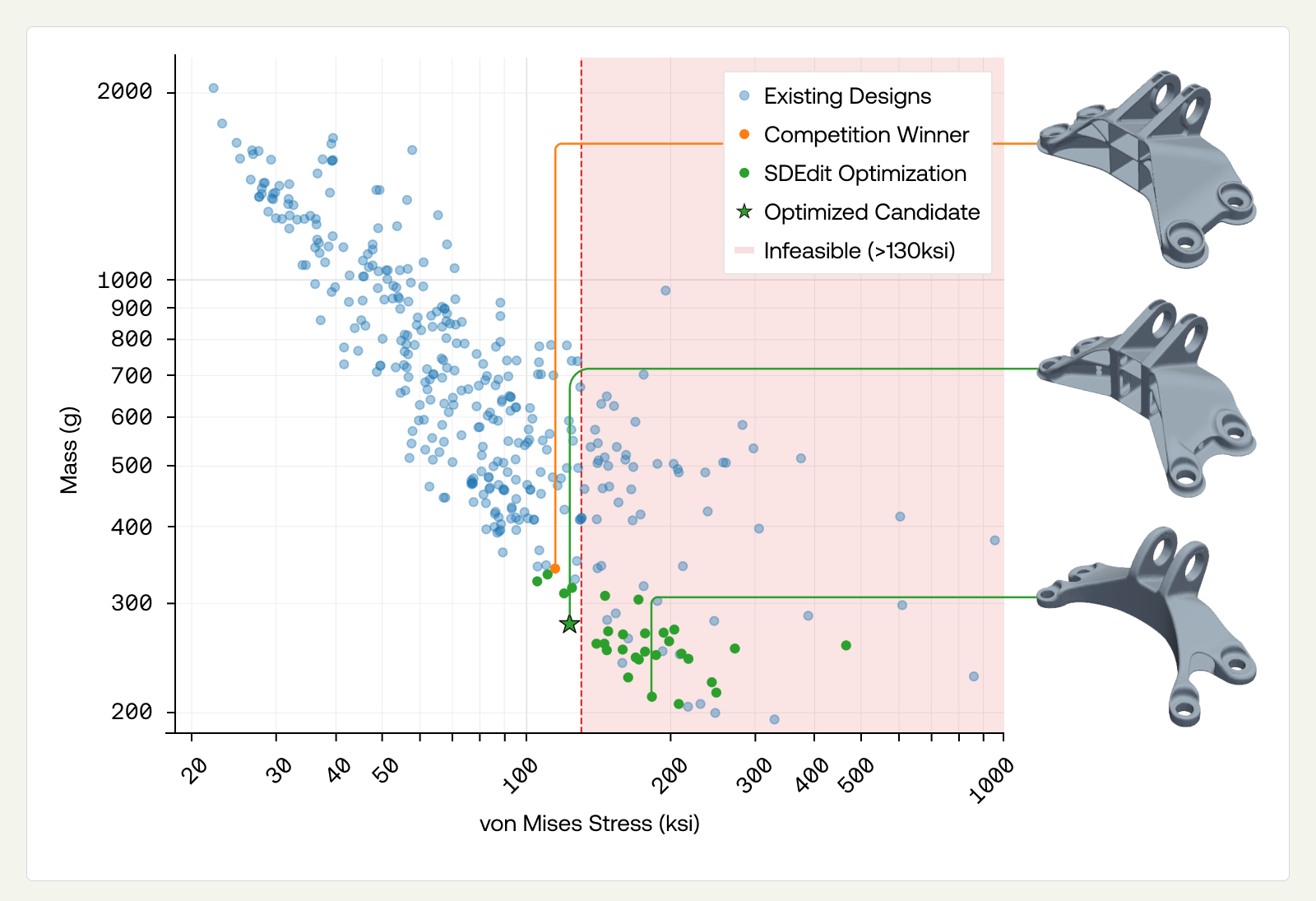
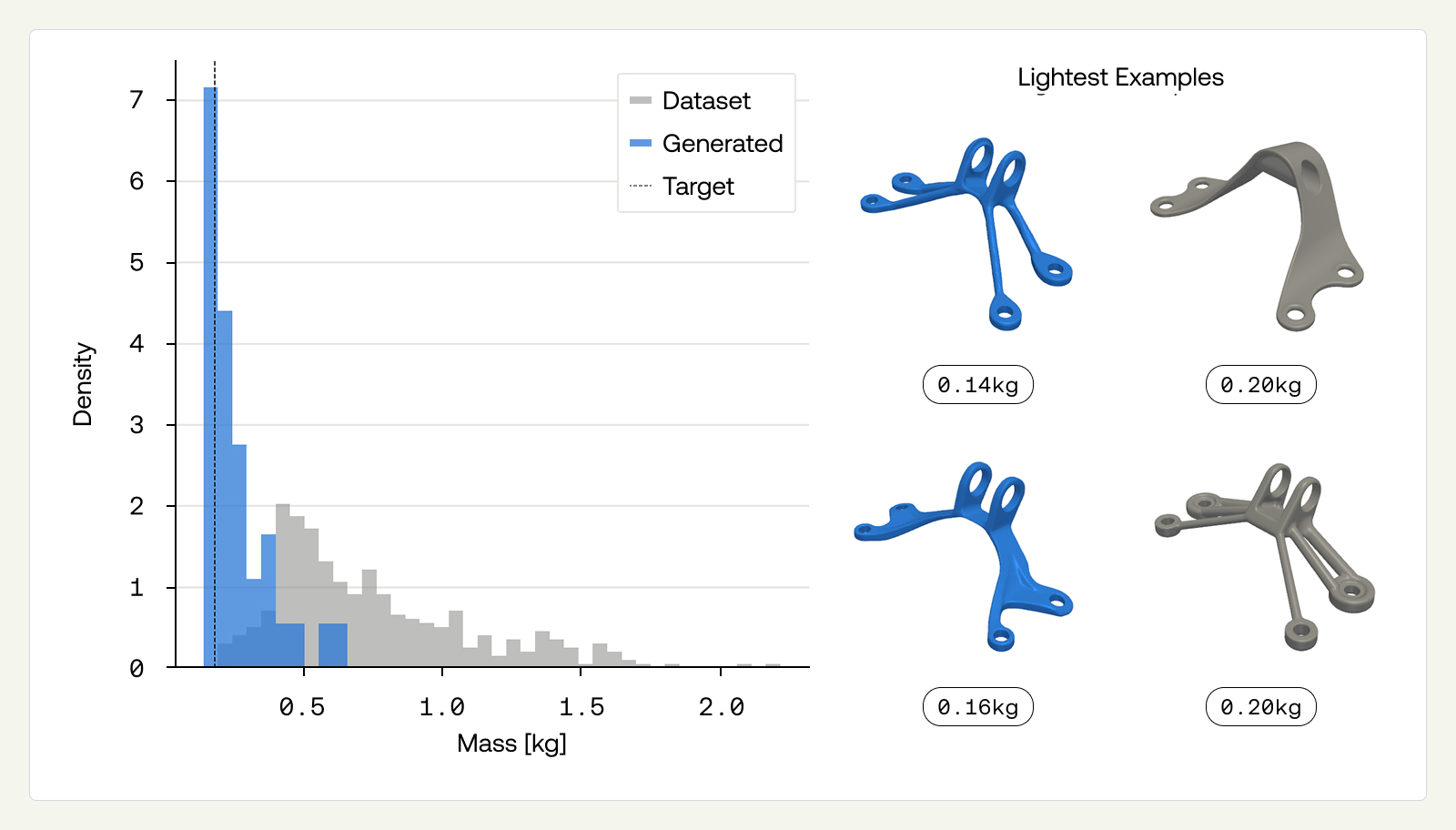
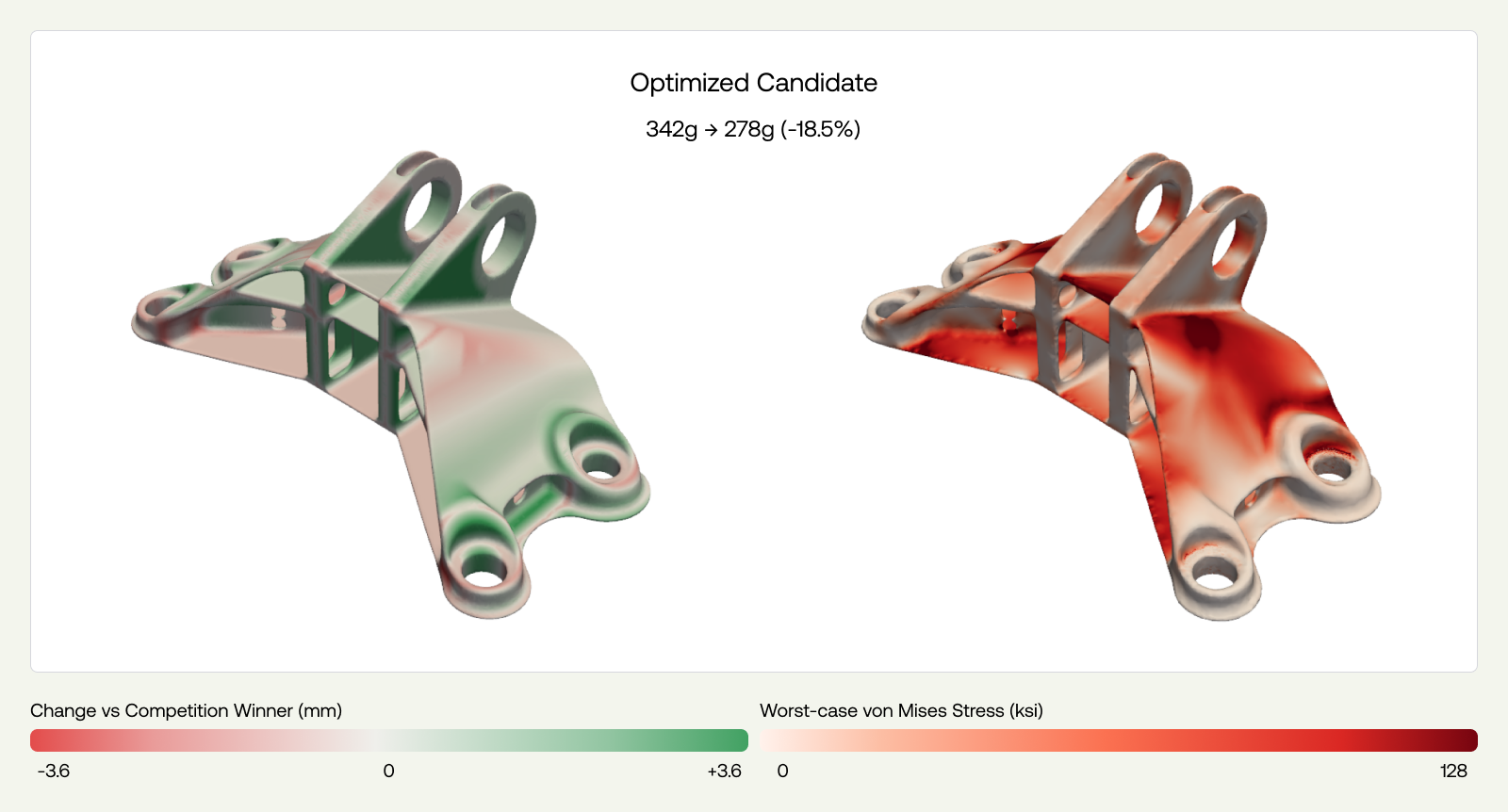
We illustrate this on the SimJEB dataset, which is derived from a competition where experts were asked to design the lightest possible jet engine bracket that did not exceed the yield stress of titanium. By one estimate, 14 human-years of effort went into this crowd-sourced and fully non-parametric dataset. We initialize an SDEdit optimization from the previous winning design and find a new solution that is 18.5% lighter while still meeting the stress constraint, using no surrogate model or CAD parameters at any stage.
Where Generative Engineering Goes Next
AI has transformed how physics is evaluated in engineering, but it has yet to have the same impact on how we interact with geometry. We believe this is the next frontier: when simulation is no longer the bottleneck, the limiting factor is the design space itself. By connecting simulation, physics AI, and geometry generation in a single workflow, the PhysicsX platform is already allowing our clients to make use of these synergies in real-world applications, from external aerodynamics to internal structures.
Though the focus of this blog is optimization, our generative framework enables other complex engineering workflows, such as inverse design, generative editing, and synthetic data augmentation, across reward fidelities from full numerical simulation, as with SimJEB (Figure 13), to deep learning surrogates. Despite this progress, a consistent theme across our research is a dissonance in complexity between open-source datasets and real engineering problems. There's a role for more sophisticated benchmarks, with reproducible simulations, to support physics AI development.
We have demonstrated examples of both constrained optimization (Figures 11, 12) and manufacturability (Figure 7), but these remain important issues to address for broader practical adoption. Underlying both challenges are suboptimal mesh representations (Figure 6). Building bespoke representations for engineering, and integrating them directly into existing CAD workflows, are promising directions for future work. Keep an eye out for further research from our team in these areas.
If pushing the frontier of what AI can do for engineering sounds like the kind of problem you want to work on, join us. PhysicsX is hiring.
References
- Chung, H., Kim, J., McCann, M. T., Klasky, M. L., & Ye, J. C. (2023). Diffusion posterior sampling for general noisy inverse problems. In International Conference on Learning Representations (ICLR 2023).
- Ho, J., & Salimans, T. (2021). Classifier-free diffusion guidance. In NeurIPS 2021 Workshop on Deep Generative Models and Downstream Applications.
- Hu, E. J., Shen, Y., Wallis, P., Allen-Zhu, Z., Li, Y., Wang, S., Wang, L., & Chen, W. (2022). LoRA: Low-rank adaptation of large language models. In International Conference on Learning Representations (ICLR 2022).
- Meng, C., He, Y., Song, Y., Song, J., Wu, J., Zhu, J.-Y., & Ermon, S. (2022). SDEdit: Guided image synthesis and editing with stochastic differential equations. In International Conference on Learning Representations (ICLR 2022).
- Sung, N., Spreizer, S., Elrefaie, M., Jones, M. C., & Ahmed, F. (2026). BlendedNet++: A dataset and benchmark for field-resolved aerodynamics and inverse design of blended wing body aircraft. arXiv preprint arXiv:2512.03280.
- Tencent Hunyuan3D Team. (2025). Hunyuan3D 2.1: From images to high-fidelity 3D assets with production-ready PBR material. arXiv preprint arXiv:2506.15442.
- Whalen, E., Beyene, A., & Mueller, C. (2021). SimJEB: Simulated jet engine bracket dataset. Computer Graphics Forum, 40(5), 9–17. https://doi.org/10.1111/cgf.14353
- Xiang, J., Chen, X., Xu, S., Wang, R., Lv, Z., Deng, Y., Zhu, H., Dong, Y., Zhao, H., Yuan, N. J., & Yang, J. (2026). Native and compact structured latents for 3D generation. In Proceedings of the IEEE/CVF Conference on Computer Vision and Pattern Recognition (CVPR 2026) (pp. 14419–14429).
- Zeni, C., Pinsler, R., Zügner, D., et al. (2025). A generative model for inorganic materials design. Nature, 639, 624–632. https://doi.org/10.1038/s41586-025-08628-5