

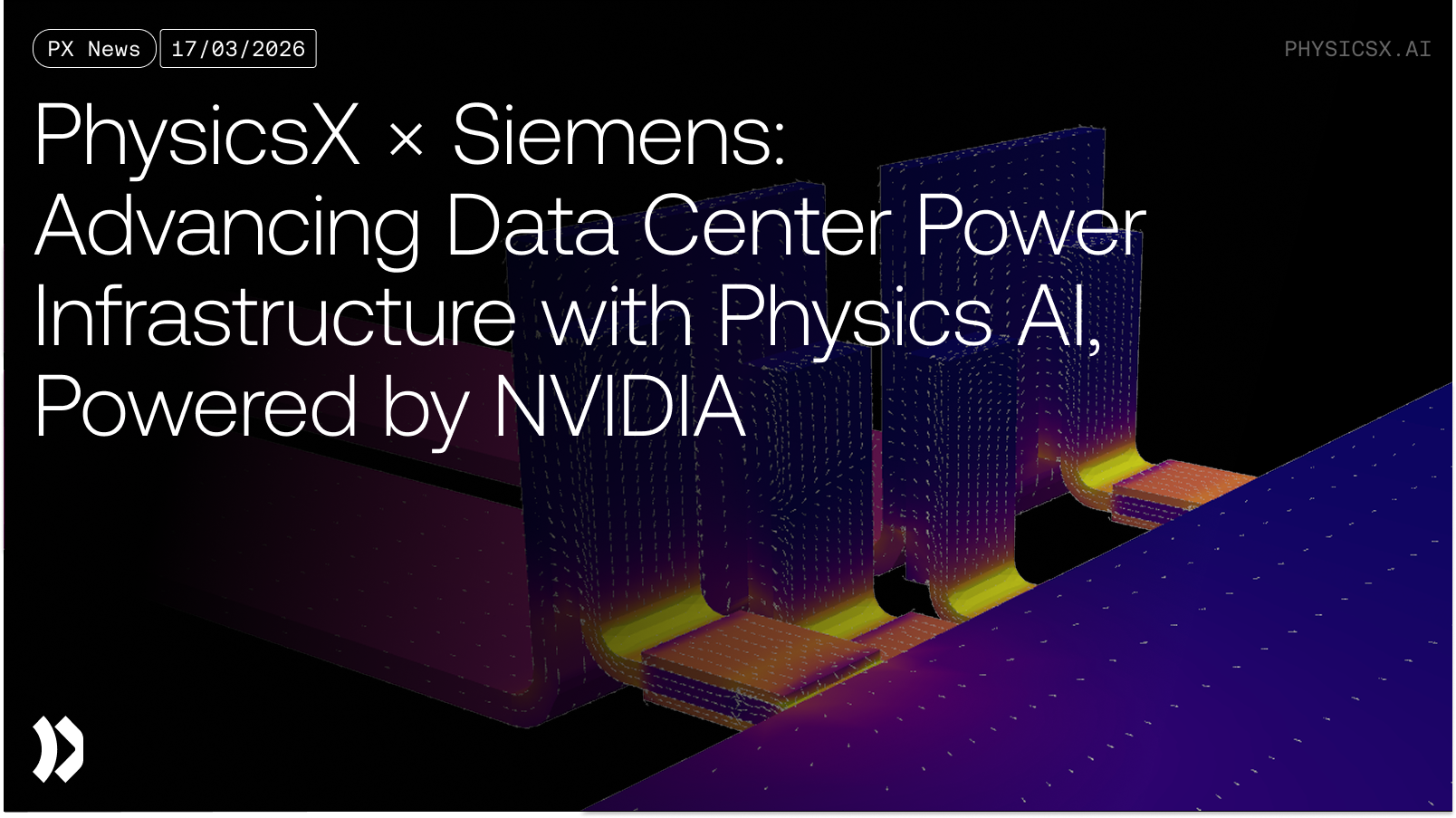
London, UK — 17 March 2026 — PhysicsX, an AI-native engineering company pioneering physics AI for industrial innovation, today announced a collaboration with Siemens Smart Infrastructure to accelerate the design and optimization of power distribution systems for next-generation AI data centers, powered by NVIDIA.
The Growing Infrastructure Challenge of AI Data Centers
As AI workloads scale rapidly and GPU clusters approach gigawatt-level power demand, the infrastructure required to deliver and manage that power has become a critical challenge. Busway systems — the backbone of high-density power distribution in modern data centers — must operate reliably under extreme and dynamically changing electrical loads. Managing the resulting thermal behavior is essential to ensuring uptime, safety, and operational efficiency.
Traditionally, evaluating and optimizing busbar thermal performance relies on high-fidelity numerical simulations that can take multiple days to execute and require specialist expertise to operate. The simulation and validation of a single busway segment under dynamic GPU load conditions can take well over twenty-four hours. Scaling this process up to an entire data center while keeping to high-fidelity simulation is infeasible, forcing engineers to make approximations and compromise fidelity to explore design trade-offs and make system-level characterization decisions.
These challenges are only exacerbated as the industry moves toward AI factory-scale infrastructure, which must deliver unprecedented levels of power density, thermal management, and operational resilience to support the compute demands of modern AI workloads.
Accelerating Engineering Workflows with Physics AI
To address these challenges, PhysicsX has partnered with Siemens to develop an AI-accelerated modeling and optimization framework built on top of Siemens’ existing multi-physics simulation workflows.
Using the PhysicsX platform and simulation data generated within Siemens’ engineering environment, the teams have developed a physics AI model capable of capturing the same multi-physics behavior and predictive fidelity as numerical simulation tools. The model is served and integrated into an interactive engineering application that provides engineers with instant, on-demand thermal predictions across a wide range of busbar configurations and load profiles.
This application enables engineers across the data center design chain — including a broader bench of system and application engineers that may not be specialized in high-fidelity simulations — to explore and evaluate power distribution performance.
From Days of Simulation to Instant Engineering Insight
With physics AI, analyses that previously required days of simulation time can now be performed in seconds, enabling engineers to rapidly explore significantly larger design spaces and stress-test configurations against highly dynamic GPU load scenarios.
Engineers can also interactively visualize temperature and current density fields in real-time, unlocking new capabilities for system optimization and paving the way for predictive monitoring of power distribution infrastructure at data-center scale.
The physics AI model is now being extended to support more complex busway components and ultimately enable facility-wide thermal management and predictive infrastructure monitoring across entire data center environments.
Through this collaboration, PhysicsX and Siemens are also extending the NVIDIA Omniverse DSX Blueprint for next-generation AI factories. The work contributes to a new engineering paradigm that combines connected industrial data, advanced multi-physics simulation, and AI-driven modeling to enable faster and more intelligent design, construction, and operational decisions for AI infrastructure.
“This collaboration demonstrates how physics AI can transform the way critical infrastructure is designed and operated,” said Jacomo Corbo, CEO and Co-Founder of PhysicsX. “As AI workloads scale rapidly, the physical systems that power the world’s data centers are becoming increasingly complex. By combining high-fidelity simulation with AI, we can give engineers the ability to analyze and optimize these systems in real-time — unlocking a fundamentally new approach to engineering design and operational decision-making. It also underscores the strength of partnership with Siemens. We’re delighted to be building together to accelerate hardware innovation around critical compute infrastructure that the world needs.”
About PhysicsX
PhysicsX is an AI-native engineering company on a mission to accelerate innovation and overhaul what engineering and manufacturing look like today. The company is building a new software stack to deliver deep physics AI enablement across the entire engineering lifecycle. PhysicsX partners with leading organizations in aerospace & defense, automotive, semiconductors, materials, and energy & renewables, supporting them on some of their most critical and complex challenges. PhysicsX is headquartered in the United Kingdom, with offices in London and New York.
For press inquiries, contact press@physicsx.ai.
About Siemens
Siemens Smart Infrastructure (SI) is shaping the market for intelligent, adaptive infrastructure for today and the future. It addresses the pressing challenges of urbanization and climate change by connecting energy systems, buildings, and industries. SI provides customers with a comprehensive end-to-end portfolio from a single source – with products, systems, solutions, and services from the point of power generation all the way to consumption. With an increasingly digitalized ecosystem, it helps customers thrive and communities progress while contributing toward protecting the planet. To protect this journey, we foster holistic cybersecurity to ensure secure and reliable operations. Siemens Smart Infrastructure has its global headquarters in Zug, Switzerland. As of September 30, 2025, the business had around 79,400 employees worldwide.
Siemens AG (Berlin and Munich) is a leading technology company focused on industry, infrastructure, mobility, and healthcare. The company’s purpose is to create technology to transform the everyday, for everyone. By combining the real and the digital worlds, Siemens empowers customers to accelerate their digital and sustainability transformations, making factories more efficient, cities more livable, and transportation more sustainable. A leader in industrial AI, Siemens leverages its deep domain know-how to apply AI – including generative AI – to real-world applications, making AI accessible and impactful for customers across diverse industries. Siemens also owns a majority stake in the publicly listed company Siemens Healthineers, a leading global medical technology provider pioneering breakthroughs in healthcare. For everyone. Everywhere. Sustainably.
In fiscal 2025, which ended on September 30, 2025, the Siemens Group generated revenue of €78.9 billion and net income of €10.4 billion. As of September 30, 2025, the company employed around 318,000 people worldwide on the basis of continuing operations. Further information is available on the Internet at www.siemens.com.