

.jpg)
Accelerating Engineering Innovation Through Physics-Based AI Agents
Modern engineering teams are asked to do the impossible: move faster, explore more of the design space, and maintain uncompromising physical accuracy. Traditional workflows force trade-offs: speed comes at the cost of fidelity; broad exploration stretches timelines; high-accuracy simulation narrows what can be tested in practice.
The PhysicsX x Microsoft collaboration is about reducing those trade-offs. By re-architecting the engineering workflow around physics-based AI agents, we bring speed, breadth, and accuracy together in a single system.
At Microsoft Ignite 2025, we showcased the technical foundation of this partnership: the PhysicsX surrogate Large Physics and Geometry Models running as agentic workflows on Microsoft Discovery, executing natively on Azure. This is the first physics-based toolchain deployed on Microsoft Discovery, and a signal of a broader shift — from sequential, human-bottlenecked engineering to continuous, AI-augmented optimization.
The Shift to Agentic Engineering
Most engineering organizations are still operating in a workflow designed for the pre-AI era defined by manual workflows. A typical development cycle looks like this: computer-aided design (CAD) → mesh generation → simulation setup → solver execution → post-processing → repeat. Each step requires specialized tools, manual data transfer, and deep domain expertise. A single computational fluid dynamics (CFD) or finite element analysis (FEA) iteration can consume days to weeks.
But the real cost is not just time. R&D teams spend a large fraction of their effort on low-value tasks: file conversions, manual parameter sweeps, monitoring long-running jobs, and report generation.
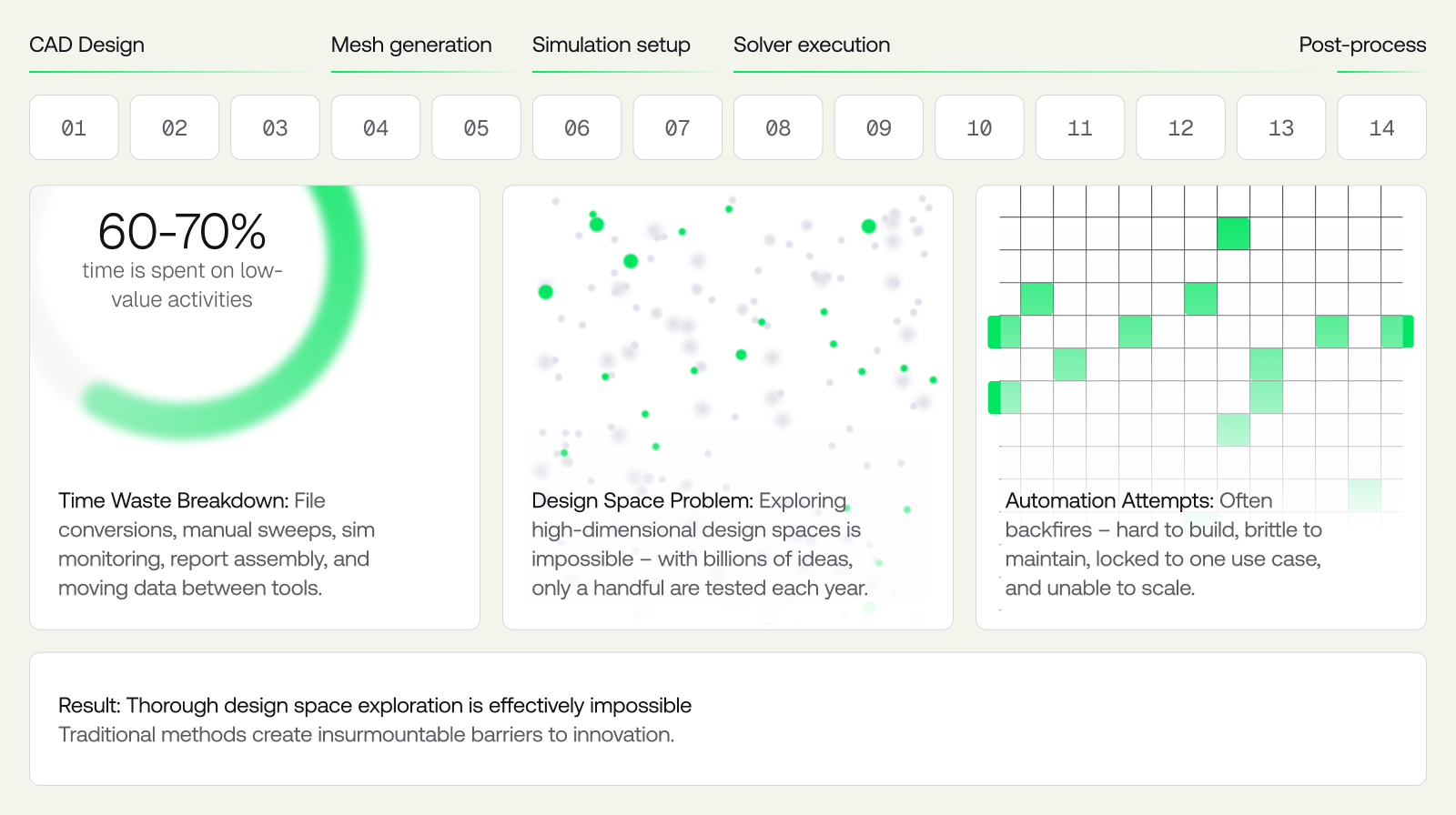
Take turbine blade design. Engineers juggle >50 variables — leading edge radius, twist angles, cooling hole positions — each demanding CFD, thermal, and structural analysis. One iteration can require two weeks of engineering effort. The design space is effectively astronomical. At 30 designs per year, teams only ever see a vanishingly small fraction of the viable options. The “best” blade may never even be considered.
Automation pipelines help, but only partially. Scripted workflows are brittle, hard to maintain, and often require software engineering skills most domain experts don’t have. Many automation efforts stall at pilot stage and never scale.
General-purpose AI systems — LLMs, SLMs, and vision models — offered a tantalizing glimpse of what might be possible. But engineering presents unique requirements that generic models cannot meet alone:
- Physical accuracy: Decision-informing models must be trained on validated physics.
- Toolchain integration: Engineering stacks are heterogeneous “frankenstacks” of CAD, computer-aided engineering (CAE), product lifecycle management (PLM), and bespoke tools that rarely interoperate smoothly.
- Enterprise constraints: Security, data governance, auditability, and compliance are non-negotiable.
- Verifiability: Engineers need traceable reasoning and a clear link from recommendations to physics and design rules.
Agents as Augmentation, Not Replacement
Agentic workflows are not a silver bullet that replaces human engineers. Rather, they strip away the mechanical work that gets in the way of engineering.
Physics-based agents in the PhysicsX x Microsoft collaboration:
- Eliminate repetitive work: They handle file format conversions, boilerplate simulation setup, documentation updates, and routine parameter sweeps.
- Unlock interoperability: Agents orchestrate tools that historically never spoke to one another. A CAD system, PLM database, CFD solver, and document generator can now be part of a single, automated workflow. The agent reads Siemens NX geometry, queries design standards in SharePoint, launches Star-CCM+ simulations, and produces reports — without manual handoffs.
- Encode and democratize expertise: Agents embed best practices, design rules, and institutional knowledge into the workflow, shortening learning curves and making advanced simulation accessible to more of the team.
- Scale senior engineers’ impact: Expert knowledge that once lived in individual heads becomes a shared, queryable resource, applied consistently across thousands of designs.
Humans stay firmly in control: setting objectives, deciding trade-offs, and validating outcomes. Agents amplify engineering judgment rather than substituting it.
The convergence of physics AI, enterprise agent platforms, and cloud-native infrastructure now makes it possible to deploy this approach at scale. The PhysicsX x Microsoft collaboration is a concrete demonstration of that convergence in production.
What We’ve Built with Microsoft: A Symbiotic Platform
In early 2023, PhysicsX and Microsoft arrived at a similar intuition from different directions:
- The Microsoft Discovery team was building a science-focused platform for AI-accelerated R&D.
- PhysicsX was developing an engineering platform that enables enterprises to harness private Large Physics Models (LPMs) and Large Geometry Models (LGMs) capable of near-real-time physical reasoning over complex systems.
The partnership aligned these efforts. PhysicsX contributes a unified platform for building, training, managing and deploying private physics and geometry models. Microsoft Discovery contributes agent orchestration, knowledge management, and tight integration with Microsoft 365 and Azure.
The joint architecture is a bidirectional integration:
- PhysicsX unlocks physics reasoning, simulation surrogates, geometry understanding, and active learning.
- Microsoft Discovery provides agent orchestration, knowledge graph and retrieval, enterprise integration, and collaboration surfaces.
- Azure provides elastic, secure compute for both fast surrogates and high-fidelity simulation.
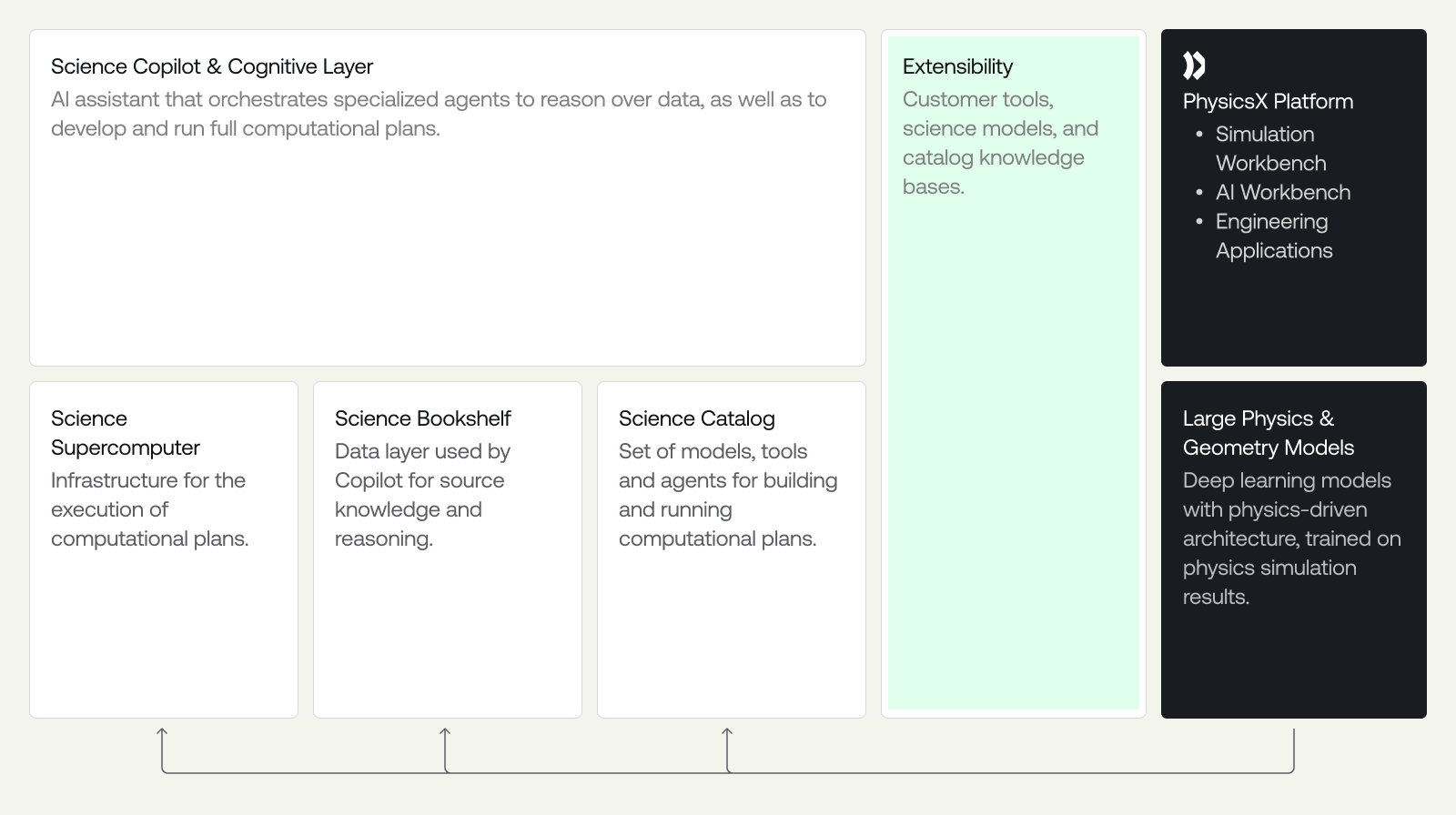
At a high level, three layers work together:
PhysicsX platform capabilities
- End-to-end lifecycle management for private LPMs: The PhysicsX platform enables the full lifecycle of private LPMs, from data generation and training to deployment and continuous improvement. These models are trained on high-fidelity simulation data to predict complex physical phenomena — including fluid dynamics, structural mechanics, and acoustics — in seconds rather than the hours required by traditional CAE solvers. The Simulation Workbench platform module accelerates high-quality data generation, while the AI Workbench supports advanced architectures such as Fourier Neural Operators and Graph Neural Networks that learn mappings between function spaces, effectively acting as universal partial differential equation (PDE) solvers across geometries and operating conditions.
- LGMs that understand and manipulate 3D geometry: Built on transformer-style architectures over point clouds, meshes, and implicit representations, LGMs encode manufacturing and design constraints directly into their latent space, ensuring that generated variants are physically realizable and manufacturable.
- Inference engine & engineering workflows: A production runtime optimized for GPU acceleration, batched inference, job scheduler, and uncertainty quantification; it delivers full-field predictions and confidence intervals rather than just point estimates.
- Active learning system: A continuous improvement loop that identifies low-confidence regions of the design space based on uncertainty quantification metrics. When a model finds itself operating in a high-uncertainty design space, it autonomously triggers high-fidelity simulations. This hybrid strategy combines the reach of surrogates with the reliability of traditional solvers.
Microsoft Discovery capabilities
- Agent orchestration: Microsoft Discovery manages multi-step investigations, coordinates specialized sub-agents, and decomposes complex engineering tasks into tractable sequences.
- Knowledge management: Engineering documentation, prior simulations, standards, and historical designs are indexed using semantic and graph-based retrieval (GraphRAG), making them instantly accessible to agents and humans.
- Discovery engine: AI-powered cognition that autonomously oversees complex projects, manages tasks, highlights insights, and speeds progress to let users focus on high-priority strategic work.
- Security & governance: Enterprise-grade authentication, authorization, and auditing ensure all actions are visible and governed.
- Microsoft 365 integration: Agents operate where engineers already work — Teams, SharePoint, Outlook, and other touchpoints across the Microsoft 365 surface.
Azure infrastructure
- Model hosting on Azure Kubernetes Service (AKS) with autoscaling.
- Elastic compute across CPU, GPU, and HPC instances for surrogate inference and full-fidelity validation.
- Enterprise security including network isolation, encryption, and compliance with key certifications.
Security by Design: Individual and Integrated Compliance
For engineering organizations, trust is as important as performance. Both the PhysicsX platform and Microsoft Discovery are independently SOC 2 compliant, and the integration preserves that security posture end-to-end.
Key guarantees include:
- Data sovereignty: Customer data and models remain within designated Azure regions.
- Access inheritance: Agents operate strictly under the identity and permissions of the authenticated user.
- Audit continuity: Calls between Microsoft Discovery and the PhysicsX platform are logged in both systems, ensuring complete traceability.
- Compliance alignment: Integrated workflows are designed to operate within SOC 2, ISO 27001, and sector-specific regulatory contexts.
Security controls cover the full lifecycle — from training data and model supply chain, through inference-time validation and access control, to monitoring and logging. For regulated industries that we operate in, this is non-negotiable.
How the Integration Unlocks New Capabilities
Together, PhysicsX and Microsoft Discovery enable capabilities that neither platform could deliver on its own:
- Contextual physics reasoning: Microsoft Discovery agents can call models trained and deployed on the PhysicsX platform to answer questions like “Will this fan geometry meet our acoustic requirements?” with quantitative, physics-grounded predictions in seconds.
- Governed design-space exploration: Agents explore the design space autonomously, but always within strict boundaries defined by engineering requirements, material limits, and manufacturing constraints.
- Human-in-the-loop validation: Critical decisions are surfaced to engineers for review, with full transparency into the agent’s reasoning and the underlying physics predictions that support each recommendation.
How the Agentic Workflow Actually Works
A Microsoft Discovery investigation powered by PhysicsX brings multiple AI systems together — LLMs for intent understanding, LPMs for physics prediction, and LGMs for geometry reasoning — into a single, orchestrated problem-solving workflow.
.png)
Phase 1: Problem setup and context acquisition
An engineer begins by generating a CAD geometry, simulation setups, or technical specifications. These are uploaded to a secure storage and, from there, the agent automatically:
- Parses native engineering formats to extract geometry, mesh details, boundary conditions, and prior simulation outputs;
- Inherits user permissions via Azure services, ensuring all actions remain within the engineer’s access rights;
- Constructs a context graph linking the investigation to relevant documentation, historical designs, and organizational standards indexed from filesystems and PLM systems.
Phase 2: Intent understanding and planning
The engineer states the goal in natural language: e.g., “Optimize this cooling fan for maximum airflow under a 35 dBA constraint” or “Explain why this bracket failed stress testing.”
Microsoft Discovery’s reasoning engine then:
- Breaks the request into sub-tasks such as evaluating the baseline, identifying failure modes, generating alternatives, and validating against constraints;
- Engages the PhysicsX platform to execute the required workflows — which coordinates physics analysis with LPMs, geometry exploration with LGMs, and multi-objective optimization;
- Asks targeted clarifications when constraints or operating conditions are ambiguous;
- Produces an execution plan with explicit checkpoints for human review, mirroring how a senior engineer would structure the investigation.
Phase 3: Autonomous design space exploration
With a plan approved, the agent proceeds into structured exploration:
- Geometric variation: The LGM generates manufacturable design variants by adjusting blade geometry, hub dimensions, or housing features while respecting constraints such as minimum wall thickness or draft angles.
- Physics evaluation: Each candidate is evaluated with PhysicsX LPMs. For example, in the case of a fan:
- Fluid dynamics LPM: flow rate, pressure rise, efficiency;
- Aeroacoustics LPM: noise spectrum and overall SPL;
- Structural mechanics LPM: stress concentrations, fatigue behavior.
- Fluid dynamics LPM: flow rate, pressure rise, efficiency;
- Multi-objective optimization: The agent identifies Pareto-optimal designs balancing competing goals (e.g., maximizing airflow while minimizing noise and maintaining structural integrity).
- Uncertainty quantification: Designs with low prediction confidence automatically trigger high-fidelity CFD or FEA validation runs on Azure.
Phase 4: Validation and verification
Throughout the workflow, agents enforce engineering standards and best practices. Phase 4 formalizes this with three layers of validation.
- Automated compliance checking: Microsoft Discovery agents continuously check designs against organizational standards encoded in the knowledge graph. Ambiguities are flagged for human review; straightforward issues are auto-corrected.
- Manufacturing constraints (wall thicknesses, draft angles, material limits);
- Modeling best practices (mesh resolution, boundary layer definitions, turbulence models);
- Internal protocols and naming conventions from SharePoint and PLM.
- Physics model validation: PhysicsX’s active learning system safeguards surrogate model reliability using multiple mechanisms:
- Anomaly detection identifies designs outside the training distribution;
- Ensemble predictions provide uncertainty estimates and confidence intervals;
- Automatic fallbacks trigger high-fidelity simulations when uncertainty is high;
- Conservation checks verify physical consistency at each prediction step;
- Cross-validation compares against known benchmark geometries.
- Human-in-the-loop review: Engineers remain central to final decision-making. The agent:
- Surfaces key findings with context, not raw data;
- Highlights trade-offs (e.g., “Design A7 meets acoustics but shows elevated hub stress”);
- Supports interactive reasoning (“Why is B3 louder?” → “Blade passage frequency aligns with duct resonance”);
- Differentiates high-confidence recommendations from areas needing more validation.
Outputs from high-fidelity simulations and real-world tests feed back into future model improvements, creating a continuous learning loop.
Phase 5: Results and iteration
The agent delivers high-level results through Microsoft Discovery’s interface which can be further investigated within the interface of the PhysicsX platform. These two interfaces are one-click away from each other and allow engineers to work immediately with:
- In-chat summaries highlighting designs that meet or exceed requirements;
- Interactive visualizations showing flow fields, acoustic maps, and stress distributions;
- Generated assets including CAD variants, solver setup files, and technical reports for PLM integration;
- Iteration pathways enabling engineers to refine constraints and continue exploration based on new insights.
Technical Differentiators
Compared to traditional workflows and generic AI tools, the PhysicsX x Microsoft approach has distinct properties:
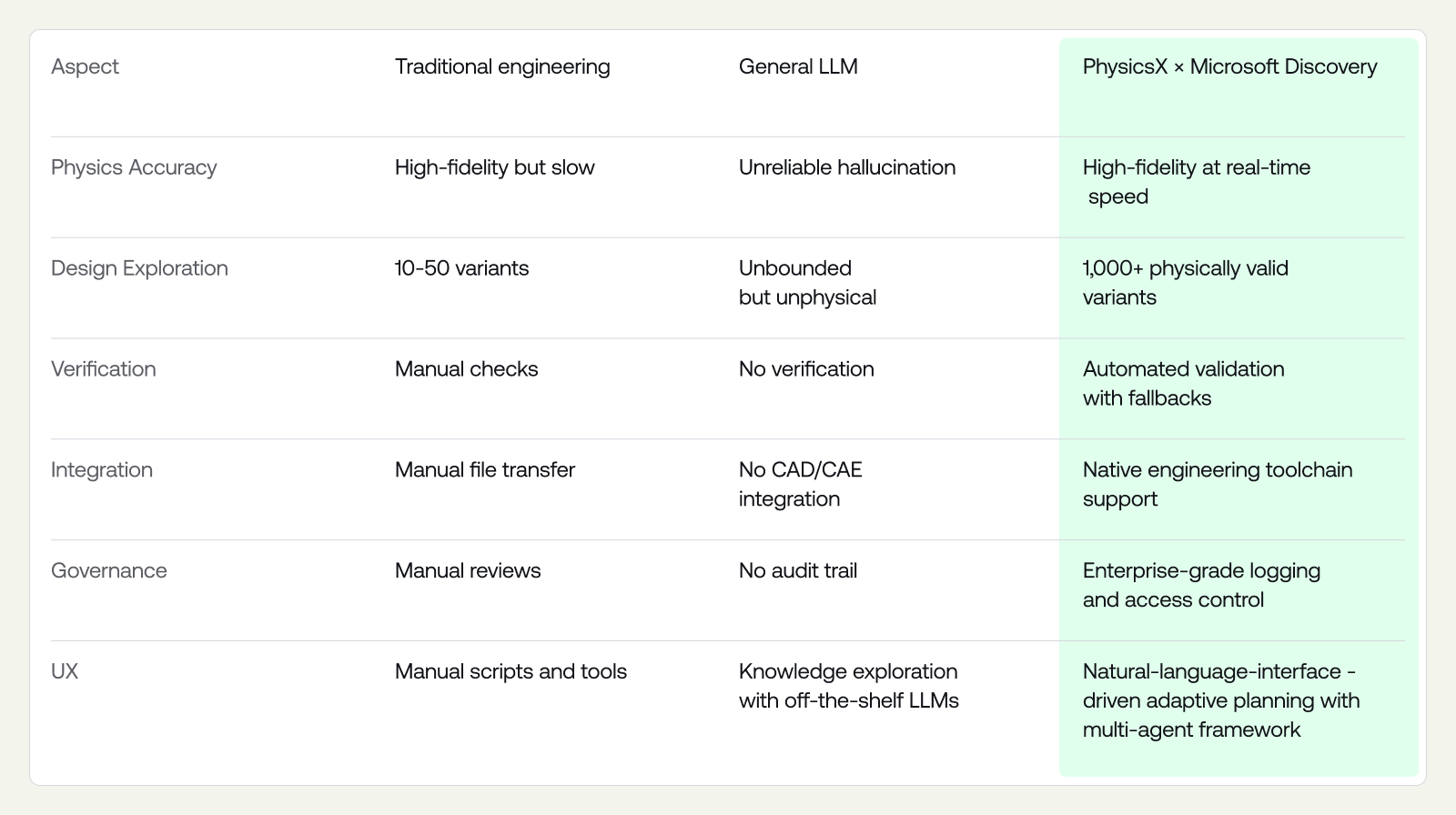
From Capability to Production: Trust and Governance at Scale
These technical differentiators signal a deeper transformation: engineering teams are moving from slow, expert-dependent CAE solvers toward real-time AI inference. But true democratization of physics-based AI is not achieved by speed alone. It requires models that are both trustworthy and operable by engineers who are domain experts — not data scientists.
The PhysicsX platform enables this shift through two foundational principles.
The first is validation against the solvers engineers already trust. Every PhysicsX foundation model is trained on high-fidelity simulation data from industry-standard solvers, never on customer data in shared models. Each simulation is checksummed, version-controlled, and fully traceable to its geometric and physical definitions. When a surrogate model enters a region of low confidence, the platform automatically escalates to these same solvers for high-fidelity evaluation, blending the speed of AI inference with the rigor of numerical simulation. Customer-specific models are trained in isolated environments to protect intellectual property while still delivering physics AI at scale. And every inference is subject to strict physical validation — conservation laws, realizability constraints, and numerical consistency — before any result is returned.
The second principle is governed agentic systems that keep engineers firmly in control. PhysicsX agents operate under strict least-privilege access, ensuring that a design agent can read CAD geometry and invoke physics models but cannot access unrelated data or systems. Agents support decision-making but do not act autonomously on high-stakes outcomes. Engineers review all recommendations with complete transparency into the agent’s reasoning, uncertainty quantification, and underlying physics predictions. This governance layer transforms AI inference from a black box into an auditable, enterprise-grade capability.
Together, these principles make physics AI accessible to users beyond simulation specialists. Broader engineering teams can now explore larger design spaces, evaluate concepts, and iterate at high velocity — without compromising the rigor required in regulated industries.
This is precisely what Microsoft Discovery gains: deep integration with the full PhysicsX platform — its foundation models, inference engine, active learning system, and governed agents — available natively within the Microsoft Discovery environment.
Conclusion: A New Era of Intelligent Engineering
The PhysicsX x Microsoft collaboration shows that agentic engineering workflows are no longer a future promise — they are operating in production today. By uniting physics-based AI models with enterprise-grade agent platforms and cloud-native infrastructure, we resolve a long-standing engineering trilemma: achieving speed, breadth of exploration, and uncompromising physical accuracy simultaneously.
This shift is not an incremental upgrade to existing tools. It fundamentally re-architectures how engineers and AI systems work together to solve complex physical problems. Engineers remain firmly in control — defining objectives, applying judgment, and validating decisions — while AI agents extend their reach, exploring thousands of design alternatives, reasoning with high-fidelity physics, and doing so within governed, auditable enterprise workflows.
Stay tuned for Part 2 or this article, where we will dive deeper into the case study — aeroacoustic fan optimization for Microsoft Surface.
Ready to rethink what your engineering organization can achieve? The PhysicsX platform is available today through the Azure Marketplace, with enterprise deployment support from Microsoft’s ISE team. Contact our team to explore applications tailored to your needs.
Technical References
The references below provide deeper technical detail on the architectures, training methodologies, and validation approaches underlying modern physics-based AI systems. The convergence of these techniques — neural operators, transformers, active learning, and uncertainty quantification — enables the agentic workflows demonstrated in the PhysicsX x Microsoft collaboration.
Foundation Models for Physics
- Li, Z., Kovachki, N., Azizzadenesheli, K., Liu, B., Bhattacharya, K., Stuart, A., & Anandkumar, A. (2020). "Fourier Neural Operator for Parametric Partial Differential Equations." arXiv:2010.08895. Introduces mesh-independent neural operators that learn solution operators for PDEs.
- Pfaff, T., Fortunato, M., Sanchez-Gonzalez, A., & Battaglia, P. (2020). "Learning Mesh-Based Simulation with Graph Neural Networks." ICLR 2020. Demonstrates GNN-based approaches for learning physics simulators on irregular meshes.
Transformers and Attention for Physics
- Hsieh, J. T., Zhao, S., Eismann, S., Mirabella, L., & Ermon, S. (2019). "Learning Neural PDE Solvers with Convergence Guarantees." ICLR 2019. Early work on neural network-based PDE solvers with theoretical convergence properties.
- Sanchez-Gonzalez, A., Godwin, J., Pfaff, T., Ying, R., Leskovec, J., & Battaglia, P. (2020). "Learning to Simulate Complex Physics with Graph Networks." ICML 2020. Framework for learning particle-based and mesh-based simulators.
Industrial Applications and Validation
- Karniadakis, G. E., Kevrekidis, I. G., Lu, L., Perdikaris, P., Wang, S., & Yang, L. (2021). "Physics-informed machine learning." Nature Reviews Physics, 3(6), 422-440. Overview of physics-informed neural networks and their applications.
- Thuerey, N., Holl, P., Mueller, M., Schnell, P., Trost, F., & Um, K. (2021). "Physics-based Deep Learning." arXiv:2109.05237. Textbook covering physics-informed deep learning for fluid mechanics and related fields.
Active Learning and Uncertainty Quantification
- Kapoor, A., Grauman, K., Urtasun, R., & Darrell, T. (2007). "Active Learning with Gaussian Processes for Object Categorization." ICCV 2007. Foundational work on active learning strategies applicable to surrogate model refinement.
- Lakshminarayanan, B., Pritzel, A., & Blundell, C. (2017). "Simple and Scalable Predictive Uncertainty Estimation using Deep Ensembles." NeurIPS 2017. Practical approach to uncertainty quantification used in production ML systems.