

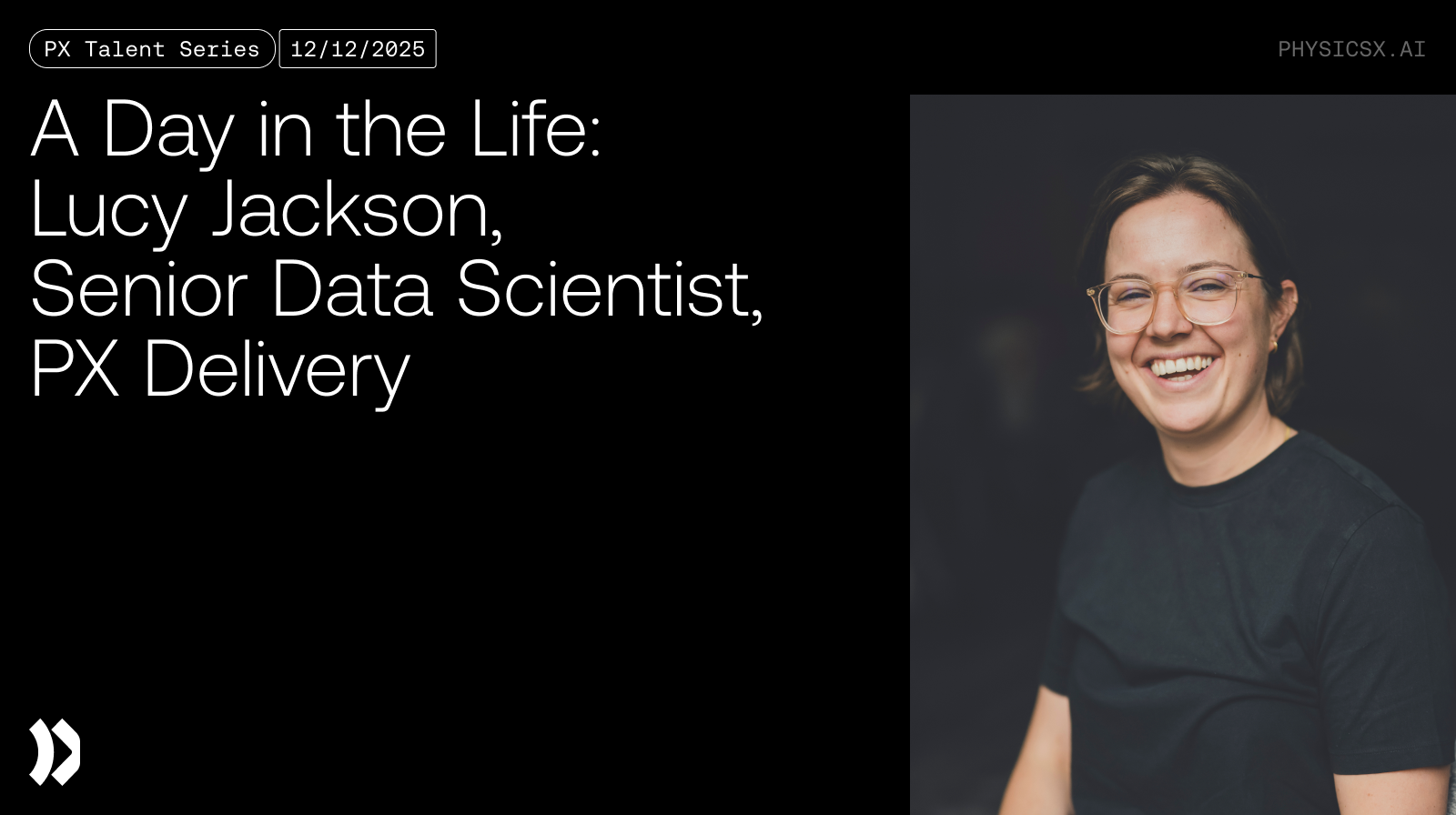
I’ve always been someone who likes to fix things. As a kid, that meant taking apart anything with screws, much to my parents’ annoyance. Later, it meant becoming an engineer. As I learned more, I found myself drawn to increasingly complex problems, ones where the “broken” thing was millions of miles away and you couldn’t just reach for a screwdriver. Space robotics became the perfect puzzle: how do you fix, adapt, and optimize systems that have to work autonomously in the harshest environments?
Halfway through my PhD, I hit a familiar wall: painfully slow design cycles. The quickest, cleanest way I found to break through that bottleneck was with AI, taking what feels like unstructured chaos and turning it into something meaningful. That moment was addictive. I began looking for other places where AI could have real, grounded impact.
Like many people working in AI, I was pulled into the language modeling wave — the problems were fascinating and the pace of innovation was exhilarating. But after a short stint, I realized that what motivates me most is solving tangible problems: the kind that exist in the physical world, with real consequences and stakes.
Climate change has always been something I care deeply about, and I couldn’t ignore the irony: the AI industry consumes massive amounts of energy while we desperately need cleaner, more efficient engineering solutions. I wanted to flip that equation, to use AI to accelerate sustainable innovation, not add to the carbon footprint.
That’s what led me to PhysicsX and, specifically, to becoming a Delivery Data Scientist — one of the most unique and impactful roles I’ve encountered in industry.
Why Delivery?
Being in Delivery means working directly with customers while also having the time and space to go incredibly deep technically. It’s the best of both worlds: you validate that you’re solving the right problem, then you get your hands dirty building the solution, and finally actually see it in use.
My favourite part of my PhD was an industry placement where I could implement real models in real production settings. Delivery at PhysicsX feels like that, but dialled up by an order of magnitude. I see the impact of my work not in papers, but in physical parts, processes, and decisions at the heart of engineering teams.
One of my proudest moments here was visiting a customer site and seeing a 3D-printed component running inside an actual machine — a part we had optimized using our models. There’s something surreal and incredibly motivating about watching your code become a piece of hardware. It’s fixing things, just like when I was a kid, except now the screwdriver is AI and the “broken” thing might be an entire industrial process.
What a Delivery Data Scientist Actually Does
My work sits at the intersection of modeling, physics, data, and practical engineering. Day to day, that looks like:
- Exploring datasets for physical insights;
- Designing or selecting the right model architectures for complex physics problems;
- Training, debugging, and validating models;
- Mapping customer workflows into PX tools;
- Collaborating with Research and Product when we need new architectures or platform capabilities.
Sometimes a project is straightforward: we use existing models and workflows already on the PhysicsX Platform, which lets us move shockingly fast. On my current project, we’ve delivered optimal designs and process configurations in weeks — something that would normally take months.
Other times the problem requires a new solution. In my previous project, no suitable architecture existed, so we built one from scratch. It was challenging but also incredibly fun — a mix of research, prototyping, and systems thinking at delivery pace.
One thing I love about working at PhysicsX is the tight loop between Delivery and Product. After finishing that research-heavy project, we spent time ensuring our new architecture used core PX libraries and integrated cleanly into the Platform. That’s a satisfying arc: from “we need something new” to “this is now part of the standard toolkit.”
A Typical Day
My mornings are sacred deep-work time. The US office is still asleep, so I usually get a solid block of uninterrupted focus, whether that’s training a model, debugging code, analyzing a dataset, or mapping how our tools should fit into a customer’s engineering workflow.
The project I’m on is at a particularly exciting stage: we’re identifying more areas within a customer’s engineering process where PhysicsX tools can make a difference.
By late morning, meetings begin: quick syncs with the Delivery team, check-ins with Product or Research, and catch-ups with the customer’s engineering leads. These sessions shape the next chunk of work, typically another deep-work block in the afternoon. Somewhere in there I stop for lunch. It’s a rhythm I really enjoy: intense focus punctuated by collaborative problem-solving with people who are just as curious and invested.
Working on site is a different kind of energy and it’s one I love.
My customer is on the US East Coast, so on-site days start early with a sync back to the UK team. Then it’s into the customer’s office, where we make the most of being face-to-face. Sitting side-by-side with their engineers and debugging the hardest parts of a workflow without screensharing lag is a game changer.
But the real value comes from following them into the labs, watching them move between computer models and test rigs, seeing which measurements they double-check, where they pause to compare simulation results with real hardware. You learn more about what actually needs fixing by watching an engineer in the lab than from weeks of requirements documents.
And simply getting to know them as people — understanding their constraints, frustrations, and ambitions beyond what’s written in a spec — transforms how you build solutions.
Lunch is in their canteen (never disappoints!), and afterwards I find a quiet corner with a good monitor to turn the morning’s work into something operational.
Evenings are for decompressing with the PX team. When you travel together, you get to know your colleagues as humans, not just avatars in meetings. Some of my favourite memories here aren’t just the technical breakthroughs, but the dinners after long days, the walks back to the hotel, the conversations that happen when everyone is equally exhausted and excited.
The Culture That Makes It All Work
What makes PhysicsX special, to me, is the combination of deep technical ambition and genuine humility. People here care about the craft of engineering and the real-world impact of what we build. Delivery, Research, and Product collaborate constantly, partly because it’s the most efficient way to execute, and partly because everyone is genuinely curious about what others are building.
There’s also an unspoken, shared motivation: we’re doing work with physical impact. Our models don’t just classify text; they shape turbine blades, optimize real-time manufacturing processes, reduce waste, and save energy. It feels meaningful.
Why I’m Here — and What’s Next
I joined PhysicsX because I wanted to use AI to solve real engineering problems with real-world consequences. Now I get to do that every day, creating tools, building models, sitting with engineers on the shop floor, and watching something I’ve helped design get printed, installed, and used.
The field is moving fast, and so are we. The problems are tricky, the physics is messy, the datasets are imperfect, but that’s exactly what makes it rewarding. There’s always something to fix, and like I’ve said, I’ve always loved fixing things.
Our Delivery team is growing! Find out what roles are open and apply here.